|
|
|
| ||||||||||||||||||||||||||||||||
|
|
calendar | calls for papers | news | file zone | discussion forum | register/my profile | what's new | jobs |
|
Home > news |
|
news24.04.2015FIRM15 focuses on Innovative Maintenance of Transport Infrastructure
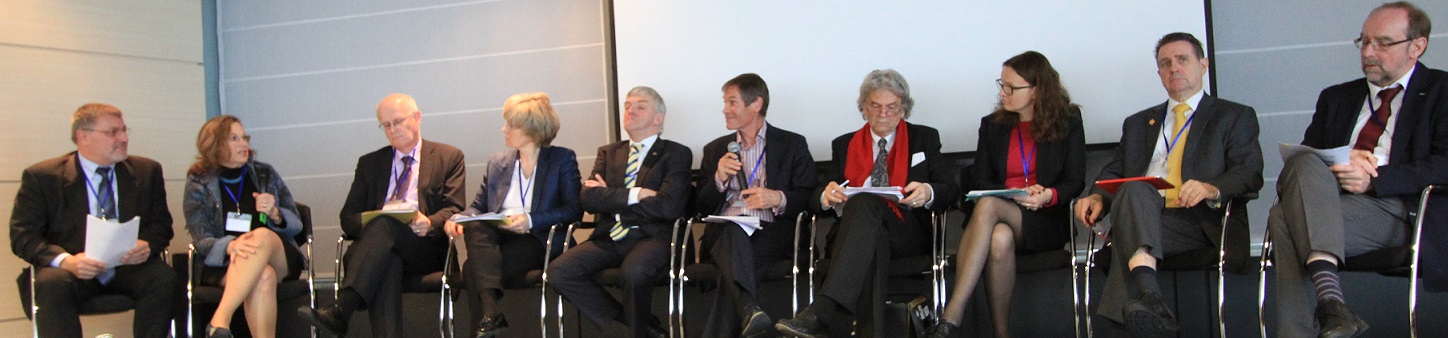
Last week (22nd-23rd April 2015), some 110 transport infrastructure research experts from Europe and beyond met for the 2015 FEHRL Infrastructure Research Meeting (FIRM15) at the Diamant Centre in Brussels, Belgium to discuss the overall theme of “Innovative maintenance of transport infrastructure: Faster, cheaper, more reliable, safer, greener”, Throughout the two-day conference, several solutions for R&D&I were presented that are in the pipeline. The debates in particular covered the challenges facing Europe, namely that little attention is given to the maintenance of transport infrastructure. While different funding mechanisms exist, these do not cover the total required costs and it is difficult to get money for maintenance. More financial support is needed (for example, through programmes such as Horizon 2020, CEDR programmes and Shift2Rail), as is expertise for construction and more knowledge about the remaining capacity of the existing infrastructure. The discussions held concluded that the scope of maintenance is broader than it used to be and the frequency higher due to the short-term timespan of infrastructure upgrades. A new maintenance framework should be found as the commercialisation and implementation of innovative solutions is too long and the actual procurement schemes are not adequate to implement innovative solutions. A change in business model is also required, which could lead to incentives (such as used in the USA) or a more normative approach (such as the European Railway Agency). And for procurement, more responsibilities and a performance-based approach (where contractors build and maintain) are also needed, which would be similar to an insurance contract. The debates also highlighted the issue of a possible backlog in the need for maintenance at the end of the contract and raised the question about whether the company who carried out the contract would even still exist then. According to the high-level participants, maintenance should be seen more as an investment to drive benefits for private partners and society/community. Transport infrastructure currently drives European competitiveness but there are no benefits retrofitted to infrastructure. For instance, a new railway or a new exit on a highway will benefit to the territory around it, but there is no reward to the infrastructure. How can part of this benefit be distributed to infrastructure? Engineers should play a role in educating both politicians and citizens and this could all form a future topic of research as well as a political mandate. Cross-modal policy content during the first plenary session This first plenary session on 22nd April 2015 featured a rich blend of high-level cross-modal speakers from industry, the National Road Authorities (NRAs), European Parliament, European Commission (EC), European Technology Platforms (ETP) and European associations who all discussed “How we can foster the Innovative maintenance of Transport Infrastructure”. FEHRL President Stefan Strick from BASt opened the meeting and Thierry Goger, FEHRL Secretary General welcomed everyone. The first speaker, Gesine Meißner, MEP Transport and Tourism Committee, Group of the Alliance of Liberals and Democrats for Europe, outlined that while more money is needed in Europe to pay for transport infrastructure, there is never enough, and welcomed industries, road users and entrepreneurs to make proposals to politicians to carry out better policy making. Ruud Smit, ERTRAC Vice-Chairman for Member States and Infrastructure, Rijkswaterstaat, outlined the details of the cross-modal roadmap for Transport Infrastructure innovation and urged FEHRL to now engage with the stakeholders to define the strategy for implementation of this roadmap. Andy Doherty, Vice-Chairman of the European Rail Research Advisory Council (ERRAC), Network Rail, was very enthusiastic about collaboration between the modes and gave ideas on innovation that both the rail and road sectors could benefit from with “Shift2Rail - How to boost innovation in the rail infrastructure sector?”. European policy priorities were outlined by Keir Fitch, Head of Unit, DG MOVE, European Commission and an industrial perspective provided by Miguel José Segarra Martínez, Head of the R&D&I Directorate, Dragados. And according to Kallistratos Dionelis, ASECAP Secretary General, who closed the session, there is a need to coordinate the mono-modal infrastructure management.
Session 2 - What are the engineering needs, challenges and solutions for Innovative maintenance of Transport Infrastructure? The first technical session, moderated successively by FEHRL Executive Director, Lutz Pinkofsky of BASt and Manfred Haider of AIT, who is also Chair of FEHRL Research Coordinators, featured an introduction by Oliver Ripke of BASt and CEDR on the needs and challenges of the Transport Infrastructure owners in terms of innovative engineering solutions. The following proposed solutions then followed from R&D&I, which focused on the progress made, the barriers to innovation and implementation of innovation, as well as the expected outcome and impact of the solutions:
Session 3 - Round table discussion: "Investing in innovative transport infrastructure, a critical matter at stake for competitiveness and social cohesion". Session 4 - What are the needs, challenges and solutions for Innovative operations maintenance of Transport Infrastructure?
Session 5 - What are the needs, challenges and solutions for Innovative governance, management and financial solutions of Transport Infrastructure?
Thierry Goger closed the event on both days. Copies of presentations can be found here and photos here.

|
||||
 |
|
| [ home | about us | activities | fehrl.tv | contact | projects | facilities | search+ ] |
| [ send link | print page ] |
| Copyright to all material on FEHRL Knowledge Centre are reserved. FEHRL Knowledge Centre's content (documents, reports, presentations, etc) can be cited, or excerpted in a sensible and proportionate manner, or e.g. included in non-commercial, on-line news digests, with proper reference (including a link) to FEHRL Knowledge Centre as the source, and to the author, by name, of any referenced post |